News
Tax Reforms Drive NRS Ambition for ₦40.7tn Revenue

Nigeria’s newly restructured revenue authority says sweeping tax reforms and expanded collection powers have positioned it to generate about N40.7 trillion in taxes and royalties, signalling a sharp escalation in federal revenue ambitions.
The Executive Chairman of the Nigeria Revenue Service, Zacch Adedeji, explained that the revised projection reflects structural changes that now place petroleum revenues, mineral royalties and other government earnings directly under the agency’s control.
According to him, the consolidation of revenue streams under a single authority significantly broadens the government’s tax base and improves efficiency in collection.
He noted that the service had already exceeded its previous benchmark by generating N28.23 trillion, surpassing its earlier target and recording a substantial year-on-year increase driven largely by stronger non-oil tax inflows.
The reforms stem from a wider fiscal overhaul introduced through legislation aimed at streamlining revenue administration. The new framework halted independent tax collection by several federal agencies, allowing them to concentrate on regulatory and operational responsibilities.
The policy shift was championed by the Presidential Fiscal Policy and Tax Reform Committee led by Taiwo Oyedele, which argued that fragmented tax collection weakened accountability and reduced government earnings.
Under the restructuring, the former Federal Inland Revenue Service was renamed the Nigeria Revenue Service and given sole authority over federal tax administration.
The reform agenda received executive backing from President Bola Tinubu, who approved the legal framework establishing the new tax architecture.
At the policy engagement session, Finance Minister Wale Edun emphasised that Nigeria’s previous reliance on deficit financing mechanisms such as Ways and Means advances had created fiscal distortions.
He also pointed to the former subsidy regime, which depended on funding arrangements involving the Nigerian National Petroleum Company Limited, describing the model as unsustainable and incompatible with long-term economic stability.
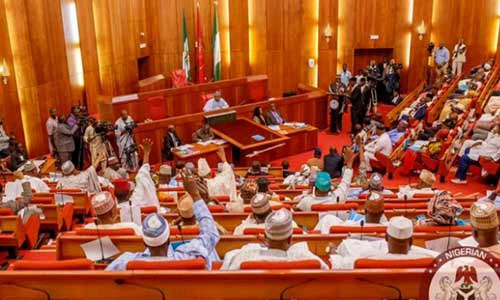
Lawmakers reviewing the revenue outlook indicated that the engagement provided an opportunity to assess performance and scrutinise projections. The Chairman of the House Committee on Appropriations, Abubakar Bichi, said parliament would seek further clarifications to ensure transparency and public understanding of the new revenue framework.
The proposed revenue target, if achieved, would mark one of the most ambitious tax-driven fiscal expansions in Nigeria’s history and reinforce the government’s pivot toward non-oil revenue generation.